
12 May 2016

14 April 2016
QRP Transceiver
This components will hopefully eventually be assembled into a 40m QRP transceiver! My son Jason KR7JAS and I are planning to each build one, according to the plans published in the March 2016 issue of QST. It involves adding an Arduino-based VFO to a Fortyniner CW kit. Fun stuff!


05 April 2016
HamRadio 360 Podcast - All About 10 Meters with KR7RK
I love listening to podcasts and one of my favorites is the HamRadio 360 Podcast. Hosted by Cale Nelson, K4CDN, the show does a nice job covering various areas of the hobby.


I was happy to be the guest speaker for the April 5, 2016 episode. Cale and I talked about my favorite amateur band, 10 meters! I was rather tired because the interview occurred right near the end of my busiest time of year (tax season), but it was a lot of fun.

When it was published, the podcast was named "Fo Time Podcast", but shortly thereafter the name was changed to "HamRadio 360 Podcast".
If the player link above does not work, you can find the show at:
The best thing to do would be to subscribe using iTunes, Stitcher, Podcast Addict, or some other version of a podcatcher software. That way you get to listen to many other great HR360 shows as well! A new show is released every 2 weeks, on Tuesdays.
24 March 2016

18 March 2016
Mesh Networking at OVARC
Tonight's monthly OVARC meeting had a good talk on Mesh Networking. Amateur operators have been setting up RF networks, often including internet access, using a combination of homebrew and commercial equipment. Some of the frequencies available to amateur operators are very near the wifi channels used by consumer routers.


15 January 2016
OVARC Monthly Meeting - K3LR Presentation
Tonight's OVARC monthly meeting had a nice presentation by Tim Duffy, K3LR. He logged in and gave the talk remotely. It's truly amazing what some hams like Tim do in this hobby!


There was a big turnout as usual. Ryan joined me as well.

12 January 2016
Remote Ham Radio
Lately I have been thinking a LOT about how to get a better station. My current home does not allow any outdoor antennas, so it's been quite an adjustment from the days when I had a 40-foot tower, SteppIR beam, and several other antennas. My old system allowed operation on any ham band from 160 meters through 70cm.
Technology is evolving but many hams are now able to access larger ham radio stations remotely via an internet link (or in some cases, a microwave RF link). There is even a new service available called "Remote Ham Radio" (RHR) that allows you to purchase time on several superstations across the country.
I have mixed feelings about remote operations. As someone who is not able to have my own base station setup, I can easily see the attraction. However, I also find myself feeling like remote operations are, to some extent, "cheating" or not as "magical", because you can greatly improve your odds of a successful contact by simply accessing a better or more advantageously located superstation. In a similar way, digital voice modes that connect to internet-linked systems leave me feeling less satisfied.
I decided to give RHR a try. They provide you with 60 minutes free, and I already had part of the equipment necessary to establish a remote connection. A few years back I had acquired a RemoteRig box with the intent of linking my office to my home, but never finished the process. You can operate RHR with only a computer, but to make it more 'radio-like' you can also use a control head. I chose to use an Elecraft K3/0 Mini control head, because the stations on the other end of RHR all use the Elecraft K3 radios so it would be a nice connection. My thought was to test the system, see if I liked it, and then possibly use a K3 setup to establish my own remote station (I don't yet have a location, but I do have a few good leads and ideas about where I can set up a station in the local area).

So how does it work? Well I have used it to log into stations in California (primarily, as it's closest to my own QTH), and New York. It has been fun - but nowhere near the same feeling as making a contact from my own home. I've worked a few DX stations, and DXCC rules allow that as long as you are in the same country. But, I don't feel right about claiming them, especially if I worked someone from New York when I know that hams here in Arizona wouldn't be able to get through. So I don't plan to use RHR for long at all. But it has been an interesting experiment and I like the K3 solution. There is a very slight but annoying time lag (latency) which makes the 2-way exchange a bit awkward.
Technology is evolving but many hams are now able to access larger ham radio stations remotely via an internet link (or in some cases, a microwave RF link). There is even a new service available called "Remote Ham Radio" (RHR) that allows you to purchase time on several superstations across the country.
I have mixed feelings about remote operations. As someone who is not able to have my own base station setup, I can easily see the attraction. However, I also find myself feeling like remote operations are, to some extent, "cheating" or not as "magical", because you can greatly improve your odds of a successful contact by simply accessing a better or more advantageously located superstation. In a similar way, digital voice modes that connect to internet-linked systems leave me feeling less satisfied.
I decided to give RHR a try. They provide you with 60 minutes free, and I already had part of the equipment necessary to establish a remote connection. A few years back I had acquired a RemoteRig box with the intent of linking my office to my home, but never finished the process. You can operate RHR with only a computer, but to make it more 'radio-like' you can also use a control head. I chose to use an Elecraft K3/0 Mini control head, because the stations on the other end of RHR all use the Elecraft K3 radios so it would be a nice connection. My thought was to test the system, see if I liked it, and then possibly use a K3 setup to establish my own remote station (I don't yet have a location, but I do have a few good leads and ideas about where I can set up a station in the local area).

So how does it work? Well I have used it to log into stations in California (primarily, as it's closest to my own QTH), and New York. It has been fun - but nowhere near the same feeling as making a contact from my own home. I've worked a few DX stations, and DXCC rules allow that as long as you are in the same country. But, I don't feel right about claiming them, especially if I worked someone from New York when I know that hams here in Arizona wouldn't be able to get through. So I don't plan to use RHR for long at all. But it has been an interesting experiment and I like the K3 solution. There is a very slight but annoying time lag (latency) which makes the 2-way exchange a bit awkward.
20 December 2015
OVARC Christmas Party
Joined the wonderful hams of OVARC for a nice potluck-style Christmas Party this afternoon.


19 December 2015
Go Box Latest Version
Today I set up in Oro Valley, AZ behind the local high school. It was chilly and breezy!


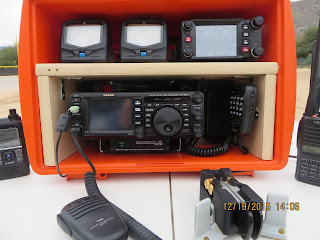

Two Ras[berry Pi's are connected to DV4mini to provide hotspot connections for DSTAR, DMR, and C4FM. The PowerAnalyzer on the left allows me to monitor battery status. 2 of the USB ports on the right provide 5vDC power to the RPi's and the other 2 are connections for the FT-991 and the WIRES-X link.

It all breaks down to a reasonable size for transport. My objective was not lightweight but I did want to keep it small enough to carry in a small car. Inside the long bag is a Buddipole HF antenna system, plus an Arrow handheld satellite VHF/UHF antenna, plus a few other antenna items.

Cabling is always a challenge, as it tends to get out of control. I needed to provide enough excess for connection cables to allow the inside tray to slide out.

Bulkheads for USB connections and coaxial cables on the inside back. A single 12VDC power in cable connects to a RigRunner distribution block. All power connections use Anderson PowerPoles for easy connections. Most connectors are labeled using a handheld label maker. The holes in the back come from previous incarnations and provided cable egress, but I find they also help keep things cool inside the box when operating.

I added a 12VDC fan to circulate air and it really helps cool things down. One area I need to improve on is grounding. Only the FT-991 had a ground terminal, but other items should be grounded as well.

The AZ dirt is hard to get a ground rod into. The battery box holds an 80AH sealed battery. On top is a 600W power inverter, but I try to avoid using that at all costs; also on top is a PWRGate block which allows me to trickle charge the battery when AC power is available.

Always a scenic view here in AZ.

The DV4minis are just above the LCD displays. These little gadgets allow me to use an HT to connect directly in to various digital reflectors around the world. The station also includes a WIRES-X digital node controller, allowing the mobile rig in the middle right to connect to System Fusion servers.

My first love is always HF, especially 10 meters. The Begali Traveller paddle allows for morse code fun, and the microphone is used for voice mode. The HF rig is also controllable from my laptop computer and with Ham Radio Deluxe, I operate various digital modes such as PSK31 and RTTY.

05 December 2015

04 December 2015
Digital Voice Modes
So many options for digital voice mode operations these days. Less than 10 years ago, D-Star hit the market and I was part of the group that got Tucson set with a D-Star repeater "stack". Now, hams are still using D-Star but we've also got C4FM/Fusion, DMR, APCO25, and more. Unfortunately they are not compatible so while the digital modes are fun technologies to play with, they do tend to split up the ham community a bit.
I've been playing around with different options, here is a test I ran using one computer to link handheld radios into two different modes. A DV4mini dongle is running DMR, while a DV3K dongle is running D-Star. The DV4mini is connected to a Connect Systems radio; the radio transmits to the dongle, which pushes it through the internet to come out anywhere in the world on the DMR systems. The DV3K is also connected to the internet, and can operate standalone to access D-Star systems around the world; an Icom radio also can connect by accessing local repeaters that are linked into D-Star.

I've been playing around with different options, here is a test I ran using one computer to link handheld radios into two different modes. A DV4mini dongle is running DMR, while a DV3K dongle is running D-Star. The DV4mini is connected to a Connect Systems radio; the radio transmits to the dongle, which pushes it through the internet to come out anywhere in the world on the DMR systems. The DV3K is also connected to the internet, and can operate standalone to access D-Star systems around the world; an Icom radio also can connect by accessing local repeaters that are linked into D-Star.

18 November 2015
Mobile Ops
Wanted to work a specific DXpedition today, but had to drive to Casa Grande for work. What to do? Stop at Picacho Peak and set up a station to make the contact!


07 November 2015
OVARC Hamfest 2015
Attended the OVARC Hamfest in Marana this morning. My son Ryan KR7YAN joined me for a while. I didn't set up a booth this time, instead just wandered around and had some fun. I attended a couple of forums on D-Star and Stealth Antennas, and cruised the swapmeet.


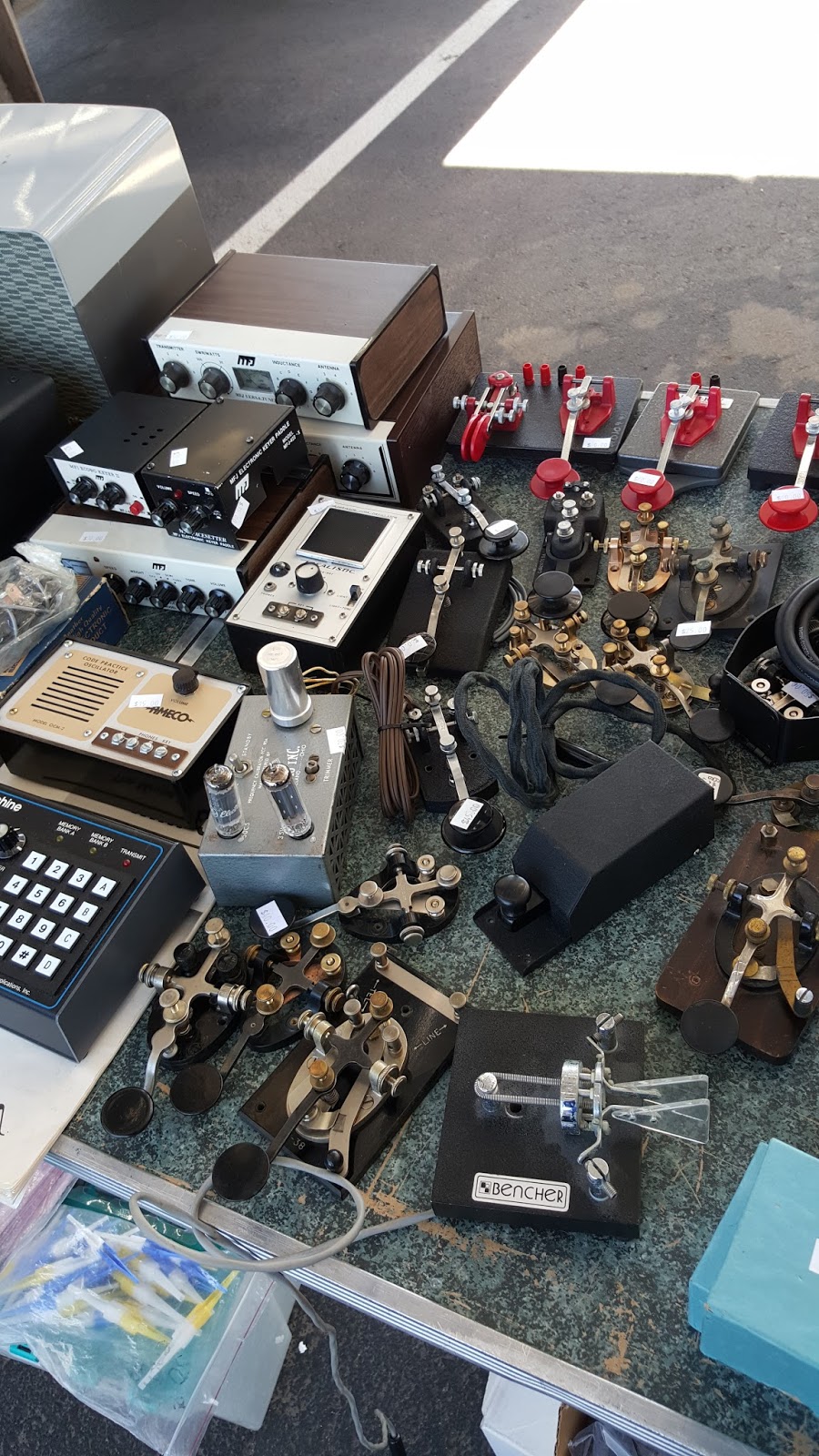
Patrick was there for the AMSAT Booth, and as he usually does, he demonstrated working an amateur satellite using a handheld beam:

17 October 2015
Go Box at Silverbell Lake
Enjoyed a little radio time lakeside today. I set up my Go Box next to Silverbell Lake, with a Buddipole dipole. I wasn't there long, as a storm was approaching, but it was fun to get out for a bit.
QSO's included some nice 10 meter DX including contacts with Ecuador and Brazil.

QSO's included some nice 10 meter DX including contacts with Ecuador and Brazil.

01 February 2012
Southern Arizona DX Association
I served as President of the Southern Arizona DX Association for a few years ending in January, 2012. We had a lot of fun and made good progress in building up the club, which has existed for many years but had gone through a slowdown. During my tenure we formalized some incorporation issues, obtained a new club call sign, developed a nice club logo, set up an arrangement with a clothing vendor for club gear, had some fantastic meeting night presentations, set up an e-mail reflector and website, donated to several large DXpeditions, and much more. It was a great time with a wonderful group of hams! They awarded me this plaque after the new President, W1KSZ, took over.

02 January 2010
DX Year 2009
Happy New Year! 2009 was a great year for DX, despite the lack of sunspots. Here's my results, courtesy of Club Log.
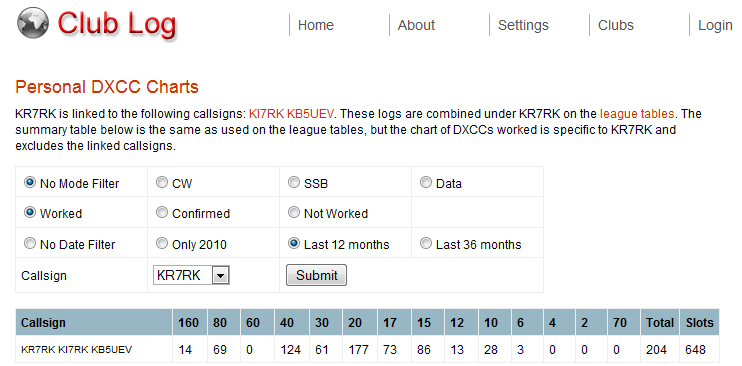
Between 1/1/09 - 12/31/09, I worked 204 unique DXCC entities, and 648 band slots.
Total QSO's were 3,034, consisting of 45% CW, 41% SSB, and 14% data modes.
Here's hoping for an even better 2010!
28 June 2009
ARRL Field Day 2009
My son Ryan, KR7YAN, and I spent the weekend of June 27-28 working ARRL Field Day with the Radio Society of Tucson, K7RST. We used the Go-Box for 10 meters and 80 meters.


01 May 2009
Texas Star Party Special Event Station
During the 2009 Texas Star Party, I spent some time operating the W5TSP special event station. We made plenty of QSO's despite the fact that most of us stayed up all night playing with telescopes all week long!

Here's my imaging scope setup on the TSP Upper Field:

31 January 2009
My Dayton Talk on The RAIN Report
The RAIN Report (Radio Amateur Information Network) apparently recorded my talk at last year's Dayton Hamvention! They have condensed it slightly and released it as the January 30th, 2009 Edition of the RAIN Report.


You can listen to the full episode here: http://kr7rk.com/R.A.I.N.%20Report%20%2001_30_2009.mp3

30 January 2009
Triple Play Award #69
I received the new ARRL Triple Play Award in less than a month! To earn this award, you need to work all 50 states on each of 3 different modes - Phone, CW, and Digital. I didn't get started until a week or so in to the new year, but once I got interested in it, I worked hard to find stations and was thrilled to be the 69th amateur to earn this new award.


Subscribe to:
Posts (Atom)